
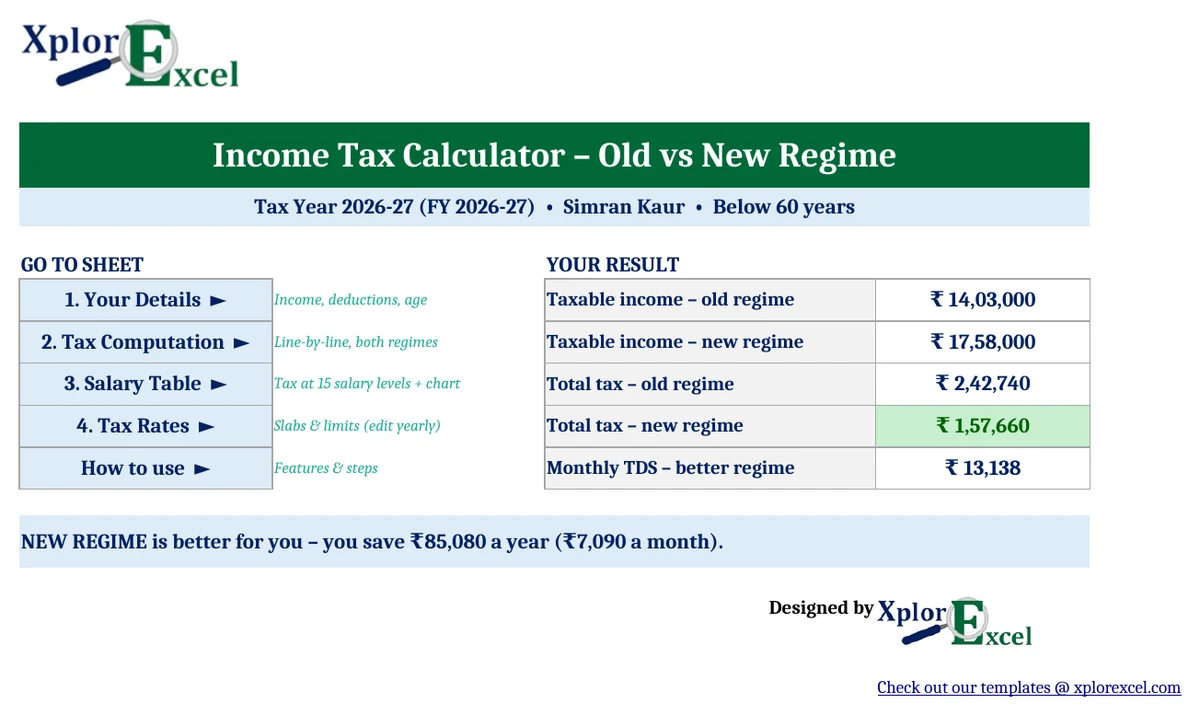
Quick answer: For tax year 2026-27 (FY 2026-27), income tax slabs are unchanged from last year. Under the new regime there is no tax on taxable income up to ₹12 lakh (₹12.75 lakh salary after the ₹75,000 standard deduction). Above that, rates run from 5% to 30%. The old regime is only better if your deductions (HRA, 80C, 80D, home loan interest and so on) are large. For example, on an ₹18 lakh salary with ₹3.8 lakh of deductions, the new regime still saves about ₹85,000. The free Xplorexcel income tax calculator FY 2026-27 in Excel works out both regimes for your own numbers and tells you which is better.
Key takeaways
- Side-by-side old vs new regime computation for tax year 2026-27, line by line.
- Includes the standard deduction, the rebate with marginal relief, surcharge with marginal relief, 4% cess, and rounding to ₹10.
- Old-regime deductions are capped at their legal limits: HRA, LTA, professional tax, home loan interest, 80C, 80CCD(1B), 80D, 80E, 80G and 80TTA/80TTB. Employer NPS counts in both regimes.
- Covers the regular, senior (60–79) and super senior (80+) slabs.
- Gives a clear verdict plus a salary table from ₹5 lakh to ₹50 lakh with a chart.
Income tax slabs for FY 2026-27
Budget 2026 made no change to slabs, the standard deduction, the rebate, surcharge or cess. From 1 April 2026 the Income-tax Act, 2025 replaces the 1961 Act and uses the term “tax year” instead of FY and AY, but the rates below still apply.
New tax regime (default), all ages
| Taxable income | Rate |
|---|---|
| Up to ₹4,00,000 | Nil |
| ₹4,00,001 – ₹8,00,000 | 5% |
| ₹8,00,001 – ₹12,00,000 | 10% |
| ₹12,00,001 – ₹16,00,000 | 15% |
| ₹16,00,001 – ₹20,00,000 | 20% |
| ₹20,00,001 – ₹24,00,000 | 25% |
| Above ₹24,00,000 | 30% |
Standard deduction: ₹75,000. Rebate: up to ₹60,000, so tax is nil up to ₹12 lakh of taxable income. Just above ₹12 lakh, marginal relief means your tax can’t be more than the income above ₹12 lakh. Maximum surcharge: 25%.
Old tax regime
| Taxable income | Below 60 | 60 to 79 | 80 and above |
|---|---|---|---|
| Up to ₹2,50,000 | Nil | Nil | Nil |
| ₹2,50,001 – ₹3,00,000 | 5% | Nil | Nil |
| ₹3,00,001 – ₹5,00,000 | 5% | 5% | Nil |
| ₹5,00,001 – ₹10,00,000 | 20% | 20% | 20% |
| Above ₹10,00,000 | 30% | 30% | 30% |
Standard deduction: ₹50,000. Rebate: up to ₹12,500, so tax is nil up to ₹5 lakh of taxable income. Surcharge can go up to 37%. A 4% health and education cess applies in both regimes.
Old vs new regime: which is better for you?
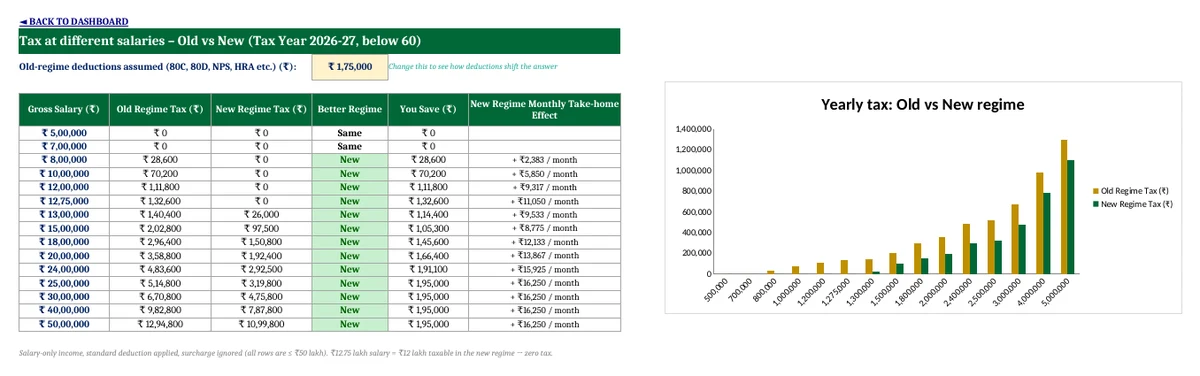
It depends on how much you can deduct under the old regime. The table below assumes ₹1.75 lakh of old-regime deductions (80C of ₹1.5 lakh plus 80D of ₹25,000) for someone below 60.
| Gross salary | Old regime tax | New regime tax | You save (new) |
|---|---|---|---|
| ₹8,00,000 | ₹28,600 | ₹0 | ₹28,600 |
| ₹12,75,000 | ₹1,32,600 | ₹0 | ₹1,32,600 |
| ₹15,00,000 | ₹2,02,800 | ₹97,500 | ₹1,05,300 |
| ₹20,00,000 | ₹3,58,800 | ₹1,92,400 | ₹1,66,400 |
| ₹30,00,000 | ₹6,70,800 | ₹4,75,800 | ₹1,95,000 |
With only 80C and 80D, the new regime wins at every salary level. The old regime starts to win when you add large HRA exemption and home loan interest on top. That’s why you should calculate with your own numbers rather than follow a rule of thumb. The template also shows how many more deductions you would need for the old regime to break even.
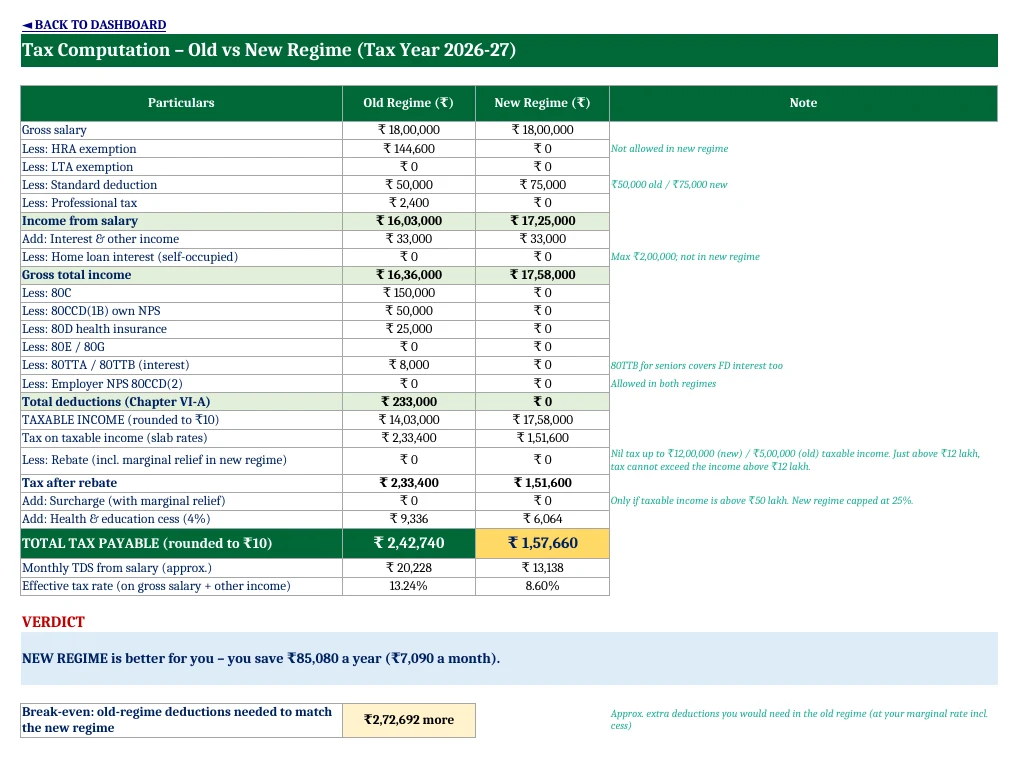
Worked example: ₹18 lakh salary, FY 2026-27
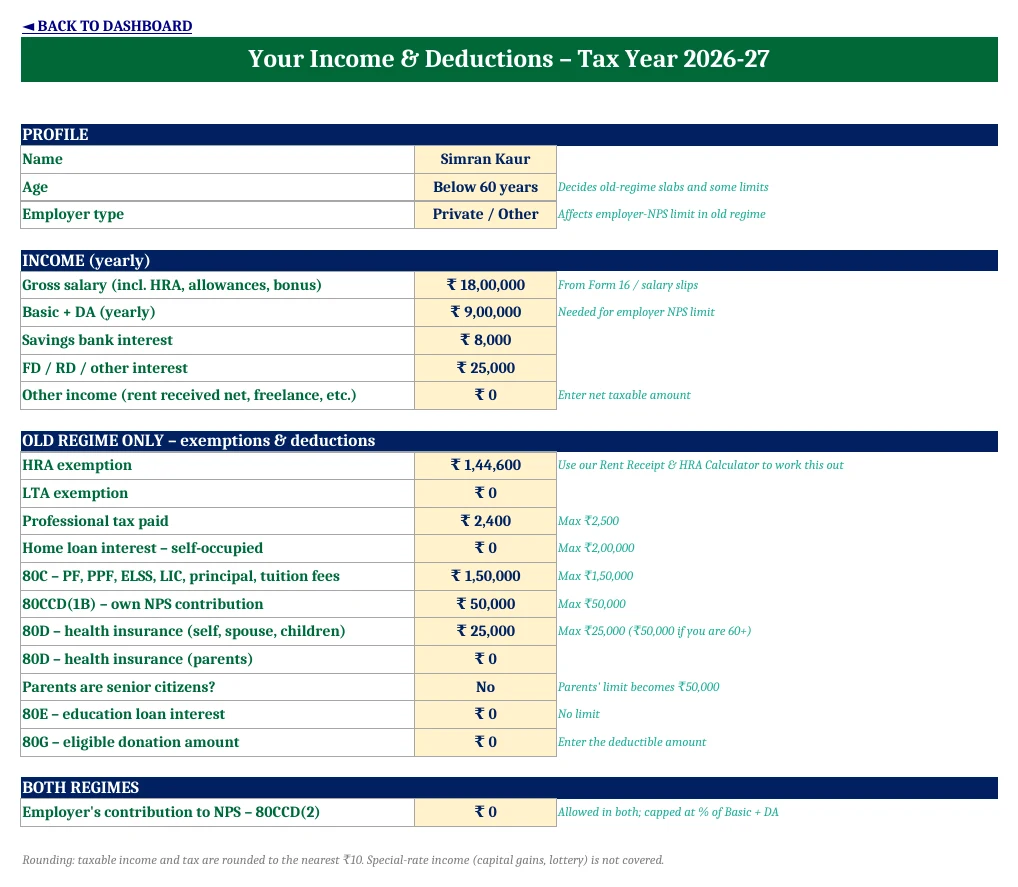
Simran is under 60 and earns an ₹18,00,000 gross salary plus ₹33,000 of interest. Under the old regime she can claim ₹1,44,600 HRA exemption, ₹2,400 professional tax, ₹1,50,000 under 80C, ₹50,000 NPS under 80CCD(1B), ₹25,000 health insurance under 80D and ₹8,000 under 80TTA.
| Particulars | Old regime | New regime |
|---|---|---|
| Gross salary | ₹18,00,000 | ₹18,00,000 |
| HRA exemption | − ₹1,44,600 | — |
| Standard deduction | − ₹50,000 | − ₹75,000 |
| Professional tax | − ₹2,400 | — |
| Interest income | + ₹33,000 | + ₹33,000 |
| Deductions (80C, 80CCD(1B), 80D, 80TTA) | − ₹2,33,000 | — |
| Taxable income | ₹14,03,000 | ₹17,58,000 |
| Tax on slabs | ₹2,33,400 | ₹1,51,600 |
| Cess 4% | ₹9,336 | ₹6,064 |
| Total tax | ₹2,42,740 | ₹1,57,660 |
Verdict: the new regime saves Simran ₹85,080 a year (about ₹7,090 a month). For the old regime to match, she would need roughly ₹2.7 lakh more in deductions.
Deductions allowed in each regime
| Deduction / exemption | Old regime | New regime |
|---|---|---|
| Standard deduction | ₹50,000 | ₹75,000 |
| HRA, LTA exemption | Yes | No |
| Professional tax | Yes (max ₹2,500) | No |
| Home loan interest (self-occupied) | Up to ₹2,00,000 | No |
| 80C (PF, PPF, ELSS, LIC, home loan principal, tuition fees) | Up to ₹1,50,000 | No |
| 80CCD(1B) own NPS | Up to ₹50,000 | No |
| 80D health insurance | ₹25,000 / ₹50,000 (senior), plus parents | No |
| 80E education loan interest, 80G donations | Yes | No |
| 80TTA / 80TTB interest | ₹10,000 / ₹50,000 (senior) | No |
| Employer NPS 80CCD(2) | 10% of Basic + DA (14% for government) | 14% of Basic + DA |
How to use the income tax calculator FY 2026-27 (3 steps)
- Your Details: Enter your age group, gross salary, Basic + DA, interest and other income. For the old regime, also enter your exemptions and deductions. The template applies each legal limit automatically.
- Tax Computation / Dashboard: Compare both regimes line by line and read the verdict and monthly TDS.
- Tell your employer: Declare the regime you’ve chosen at the start of the year so the right TDS is deducted. You can still switch when filing your return, subject to the rules for your income type.
Tip: To work out your HRA exemption, use our free Rent Receipt Generator with HRA Calculator. It uses the new 50% limit for Bengaluru, Hyderabad, Pune and Ahmedabad.
Download the Income Tax Calculator FY 2026-27 (Free)
File: Income Tax Calculator FY 2026-27 Old vs New Regime 1.0 · Format: .xlsx · Macros: none · Price: free.

Income Tax Calculator FY 2026-27 Old vs New Regime 1.0
All rates are on one Tax Rates sheet, so the calculator is easy to update after each Budget.
Frequently asked questions
Is income up to ₹12 lakh tax-free in FY 2026-27?
Yes, under the new regime. Taxable income up to ₹12,00,000 has zero tax because of the rebate of up to ₹60,000. For salaried people, that works out to a salary of up to ₹12,75,000 after the ₹75,000 standard deduction. This doesn’t apply to special-rate income such as capital gains.
Which tax regime is better for FY 2026-27?
For most people the new regime is better unless their old-regime deductions are large. As a rough guide, the old regime starts to make sense when HRA, home loan interest, 80C, 80D and NPS together come to well over ₹4 lakh a year. Calculate with your own figures to be sure.
Did Budget 2026 change income tax slabs?
No. Budget 2026 kept the slabs, standard deduction, rebate, surcharge and cess the same as FY 2025-26. The new Income-tax Act, 2025 takes effect from 1 April 2026.
What is marginal relief under the new regime?
If your taxable income is just above ₹12 lakh, your tax can’t be more than the amount by which your income exceeds ₹12 lakh. For example, at ₹12,25,000 of taxable income the tax is capped at ₹25,000 (plus cess). The calculator applies this automatically.
Can salaried employees switch between old and new regime every year?
Yes. Salaried individuals without business income can choose either regime each year. People with business or professional income have stricter limits on switching.
Is the standard deduction available in both regimes?
Yes. It’s ₹75,000 under the new regime and ₹50,000 under the old regime, for salaried employees and pensioners.
Can I use this income tax calculator in Google Sheets?
Yes. Upload the .xlsx file to Google Drive and open it with Google Sheets. It has no macros.
More free finance templates from Xplorexcel
- Rent Receipt Generator with HRA Calculator
- Attendance and Salary Sheet with Salary Slip
- Loan EMI Calculator with Prepayment
- Saving Tracker Template
- All Excel templates
Disclaimer: This calculator gives an estimate for resident individuals with salary and normal-rate income. It does not cover capital gains at special rates, presumptive business income or AMT. Verify with the Income Tax Department’s calculator or a tax professional before filing. Last reviewed: September 2026.