
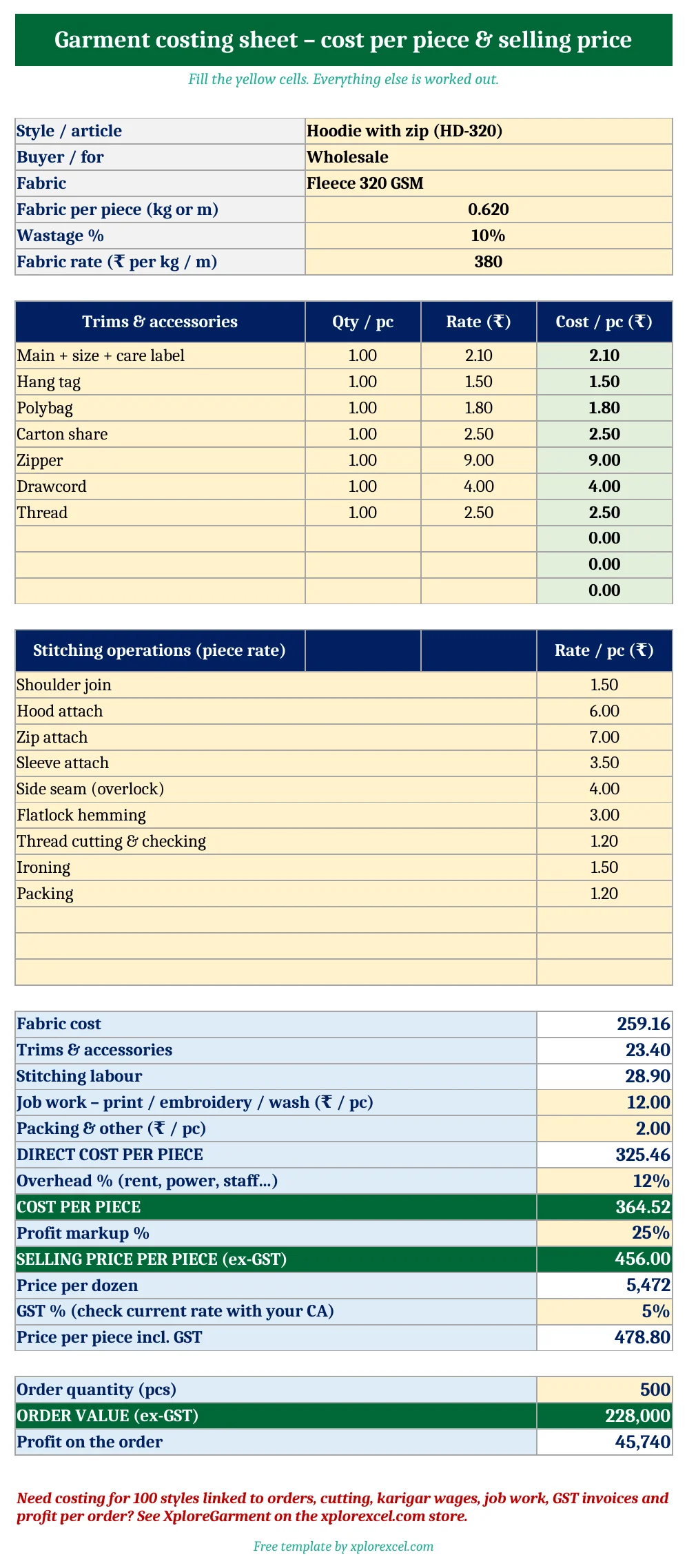
Quick answer: Garment cost per piece = fabric (fabric per piece × (1 + wastage %) × fabric rate) + trims + stitching labour (the piece rates of all operations) + job work (print, embroidery, wash) + packing, plus your overhead %. Add your profit markup to get the selling price. Download a free garment costing sheet in Excel below. It also has a fabric consumption calculator: kg for knits from GSM, and metres for wovens from pattern parts.
Key takeaways
- Cost sheet: fabric, 10 trims, 12 stitching operations, job work, packing, overhead and markup give cost per piece, price per dozen and order value.
- Knit consumption: kg per dozen from body length, sleeve, half chest, allowances and GSM.
- Woven consumption: metres per piece from pattern parts, fabric width and marker efficiency.
- GSM – metre – kg converter for buying fabric. Free, with no macros.
How to cost a garment, step by step
- Fabric: work out fabric per piece (see the calculator below), add wastage (usually 5–10%), and multiply by the fabric rate per kg or metre.
- Trims and accessories: labels, hang tag, polybag, carton share, buttons, zipper, drawcord, elastic and thread, each at qty × rate.
- Stitching labour: add the piece rate of every operation. If you pay monthly salaries instead, divide the monthly wages by pieces made.
- Job work: printing, embroidery, washing or dyeing per piece.
- Overhead: rent, electricity, cutting master and helpers, machine repair. Most small units use 10–15% of direct cost.
- Markup: your profit %. Check it against what the buyer will pay per dozen.
Fabric consumption formula
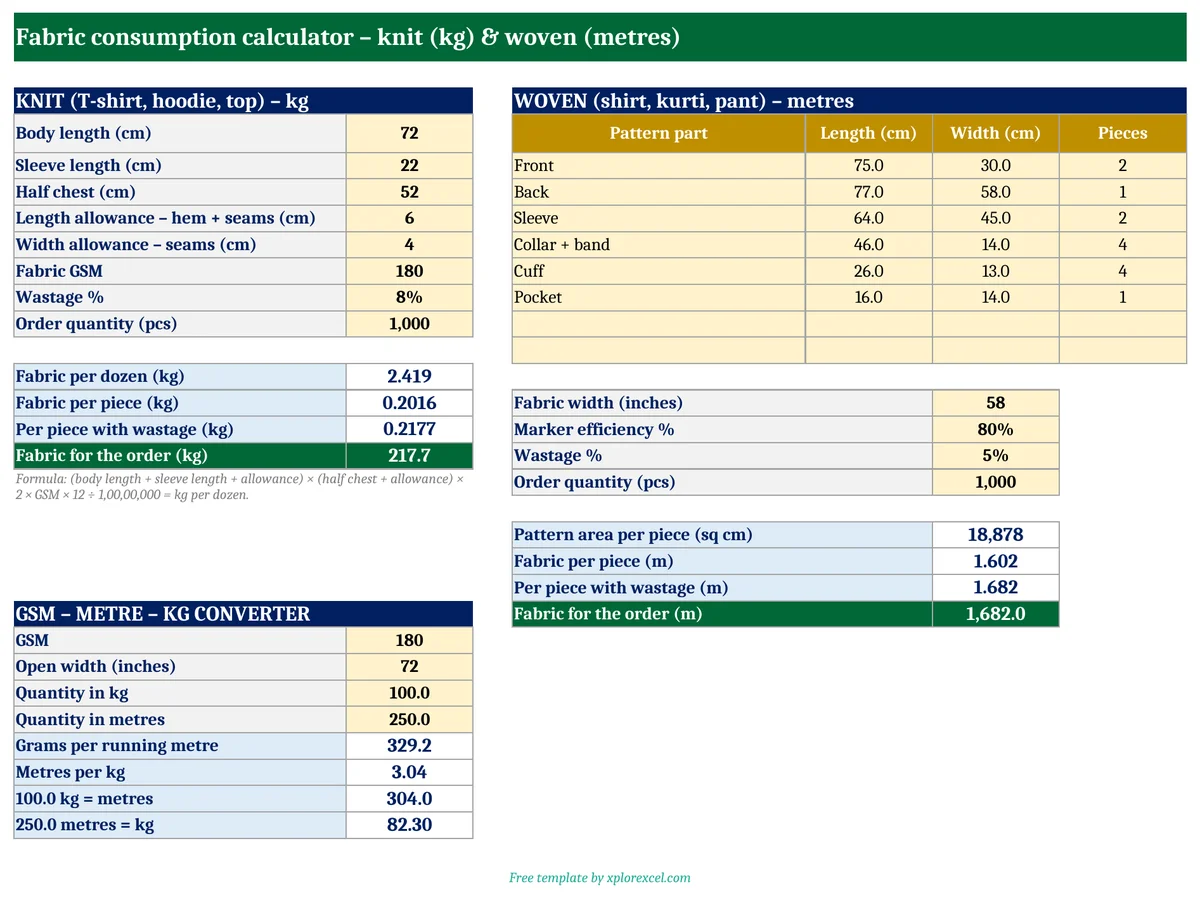
Knit (T-shirt, hoodie): kg per dozen = (body length + sleeve length + allowance) × (half chest + allowance) × 2 × GSM × 12 ÷ 1,00,00,000, with all measurements in cm.
Example: a T-shirt with body 72, sleeve 22, half chest 52, allowances 6 and 4, and 180 GSM needs 2.419 kg per dozen. That is 0.20 kg per piece, or 0.218 kg with 8% wastage.
Woven (shirt, kurti): add up the area of every pattern part (length × width × number of pieces). Divide by the fabric width in cm × marker efficiency to get the metres per piece.
GSM to metres: grams per running metre = GSM × width in metres. Metres per kg = 1,000 ÷ that.
Tips for accurate costing
- Cost from a sample piece, not a guess. Weigh the cut panels of one piece to check knit consumption.
- Compare fabric used per piece in cutting with your costing on every order. A 5% gap on fleece can wipe out your profit.
- Re-cost when the fabric rate moves. Yarn and fabric prices change every season.
- Quote per dozen to wholesalers and per piece to retailers, and keep GST separate (ex-GST price).
Running a stitching unit? XploreGarment – Garment Unit Manager in Excel costs up to 100 styles and links them to:
- size-wise orders and a cutting register that catches fabric wastage
- karigar piece-rate wages with a wage slip
- job work sent and received
- a GST invoice with CGST/SGST or IGST
- buyer dues and profit on every order
Download the free Garment Costing Sheet & Fabric Consumption Calculator
There are two sheets: Costing Sheet and Fabric Consumption. Fill in the yellow cells; everything else is worked out.

FAQs
What overhead % should a garment unit use?
Add up a month’s rent, power, salaried staff and repairs, then divide by that month’s direct cost of production. Small units usually land between 8% and 15%.
What is CMT cost?
Cut-Make-Trim: the cost of cutting, stitching and finishing when the buyer supplies the fabric. In this sheet, set the fabric rate to 0 and the rest is your CMT price.
Which GST rate applies to garments?
GST on garments depends on the sale value per piece, and the rates and limit have changed in the past. Check the current rate with your CA and type it in the sheet.
