
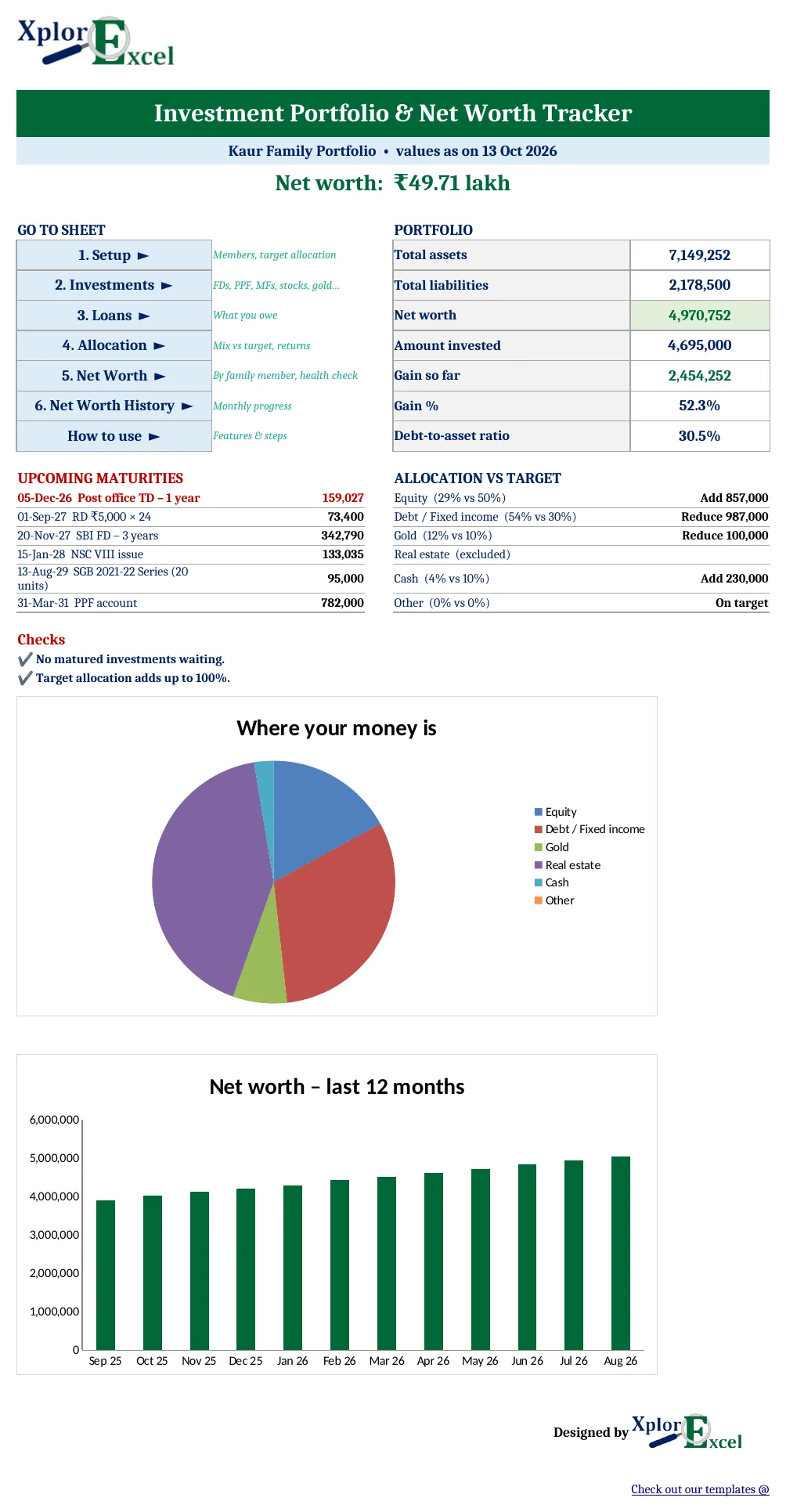
Quick answer: Your net worth is everything you own minus everything you owe: Net worth = total assets − total liabilities. Assets include FDs, PPF, EPF, NPS, mutual funds, shares, gold, property and cash. Liabilities include home, car and personal loans and unpaid credit-card balances. The free Xplorexcel tracker keeps all of your family’s investments and loans in one Excel file. It works out FD values for you, shows the gain on every investment, compares your asset mix with a target, lists upcoming maturities and charts your net worth month by month.
Key takeaways
- Every Indian investment type: FD, RD, PPF, EPF, NPS, mutual funds, stocks, post office schemes, bonds, physical gold, SGB, real estate and cash.
- FD values update themselves. Enter the interest rate and the template compounds quarterly up to today or the maturity date.
- Net worth for the family and for each member, with holder and nominee recorded for every investment.
- Asset allocation against your target, showing exactly how much to add to or reduce in each group.
- Maturity alerts, a financial health check and a monthly net worth history chart.

How to calculate your net worth
- List every asset at today’s value. For mutual funds and shares, take the value from your app or consolidated account statement (CAS). For PPF, EPF and NPS, use the latest passbook balance. For gold, use today’s buying rate.
- List every liability at the outstanding amount, meaning the principal still owed, not the total of future EMIs.
- Subtract liabilities from assets.
- Repeat every month or quarter. One number on its own says little. The trend tells you whether you’re moving in the right direction.
In the sample family file, assets are ₹71.49 lakh and loans are ₹21.79 lakh, so net worth is ₹49.71 lakh. The debt-to-asset ratio is 30.5%.
FD value calculated automatically
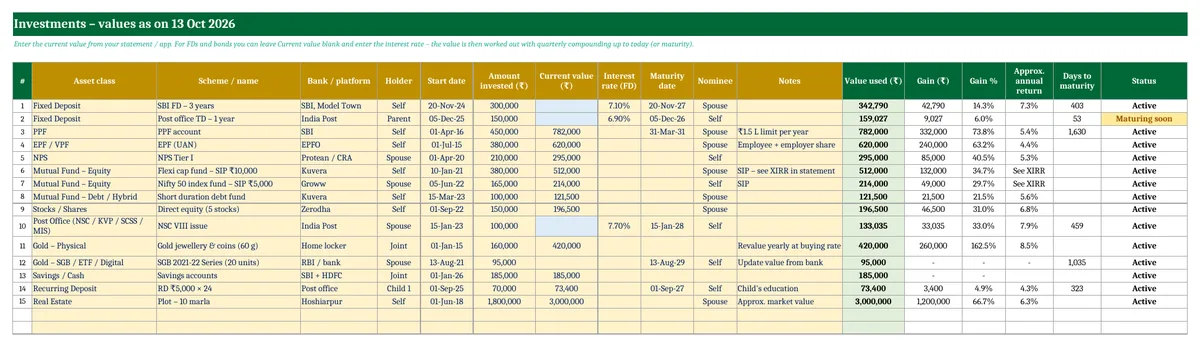
For a fixed deposit you don’t have to look up the value every month. Leave Current value blank and enter the interest rate, and the template applies quarterly compounding, which is how most banks calculate FDs:
Value = Principal × (1 + rate ÷ 4)4 × years
For example, ₹3,00,000 at 7.1% from 20 November 2024 is worth about ₹3,42,790 on 13 October 2026. The calculation stops at the maturity date. For mutual funds, shares, gold and other market-linked investments, enter the current value from your statement.
Asset allocation: are you in the right mix?
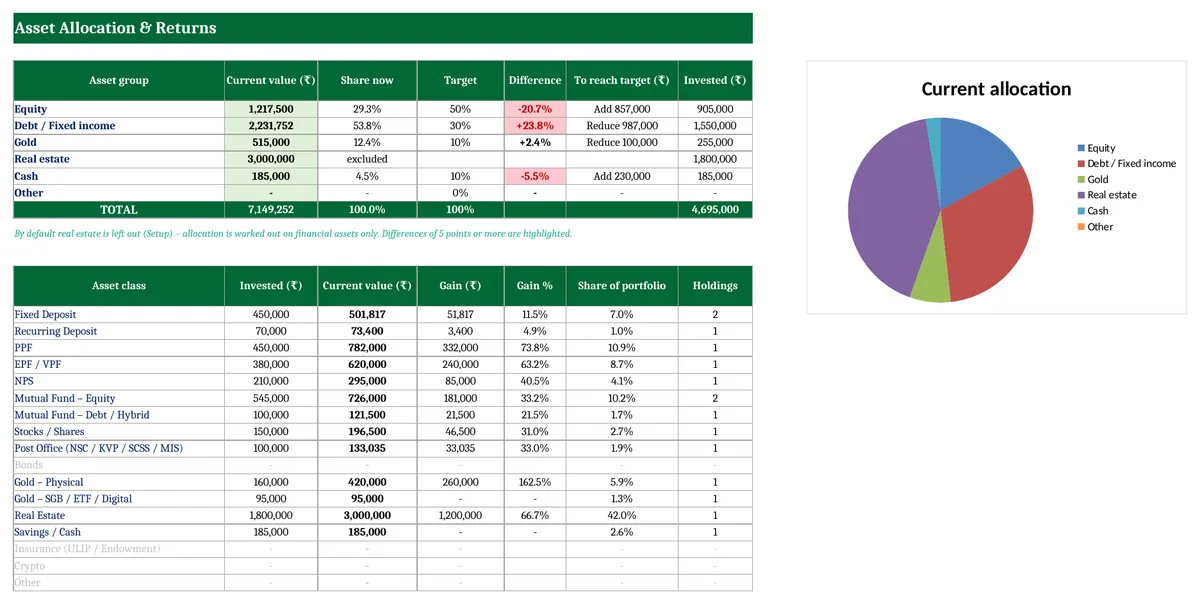
Each investment type rolls up into one of six groups: Equity, Debt / Fixed income, Gold, Real estate, Cash and Other. Set your own target on the Setup sheet. The Allocation sheet then shows your current share of each group, how far it is from the target, and how much to add or reduce to rebalance.
Real estate is left out by default, because most people don’t buy or sell a house to rebalance a portfolio. The allocation is then worked out on financial assets only. In the sample, equity is 29% against a 50% target, so the sheet says to add about ₹8.57 lakh to equity, while debt is 24 points over its target.
Net worth for each family member, and a health check
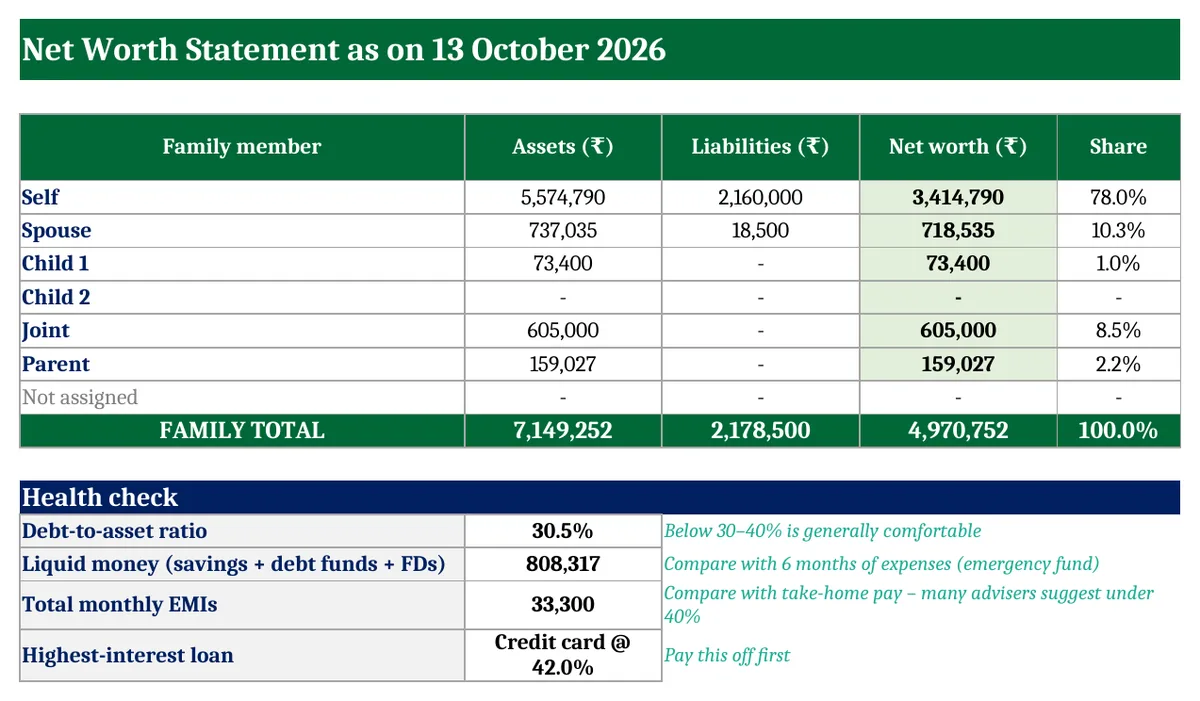
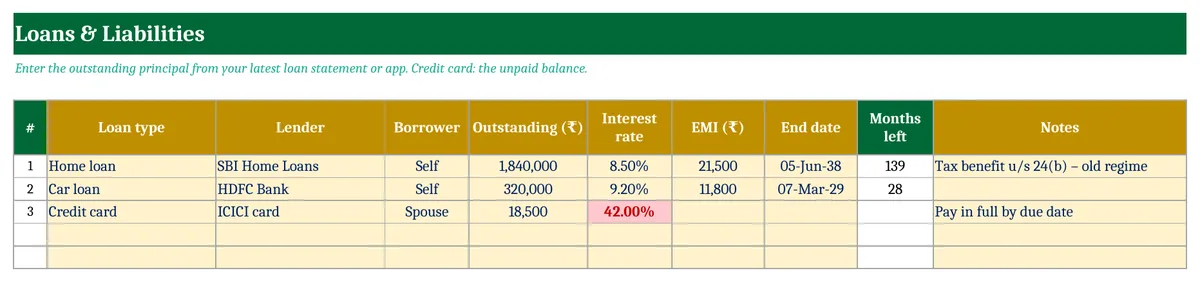
Every investment and loan has a holder, so the Net Worth sheet splits assets, liabilities and net worth by family member: self, spouse, children, joint and parents. Below that, a quick health check shows:
- Debt-to-asset ratio: loans as a share of assets.
- Liquid money: savings, FDs and debt funds, to compare with six months of expenses as an emergency fund.
- Total monthly EMIs: to compare with your take-home pay.
- Costliest loan: usually the credit card, which is the one to clear first.
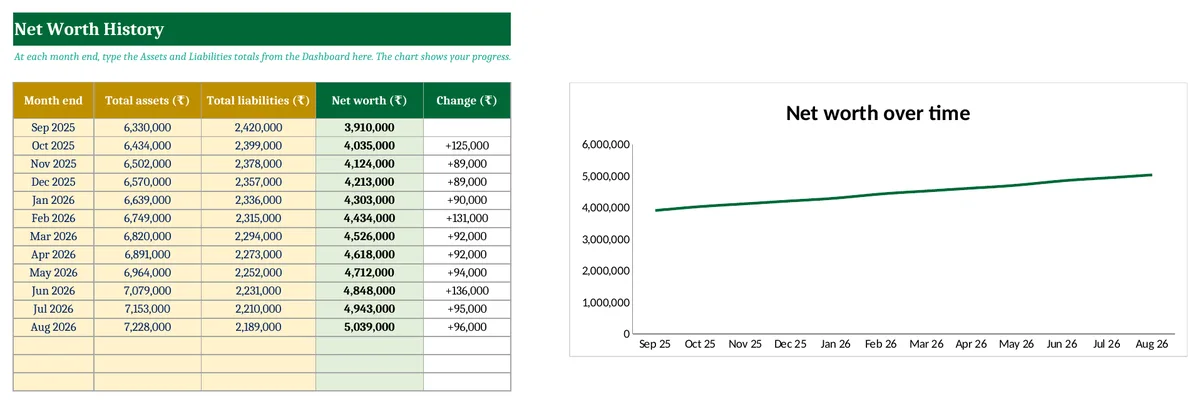
Track your net worth over time
At each month end, copy the asset and liability totals into Net Worth History. The chart shows how your wealth grows as you pay down loans and keep investing.
How to use the net worth tracker (4 steps)
- Setup: Enter your family members and your target allocation, which must add up to 100%.
- Investments: Add each holding. Update its current value from statements every month or quarter. For FDs, just enter the interest rate.
- Loans: Add the outstanding amount, rate, EMI and end date of each loan or card.
- Dashboard: Check your net worth, maturities and allocation. At month end, add a line to Net Worth History.
Download the Net Worth Tracker in Excel (Free)
File: Investment Portfolio and Net Worth Tracker 1.0 · Format: .xlsx · Macros: none · Price: free.
Get updates and new free templates
Your download below doesn’t need this. Leave your WhatsApp number or email and I’ll send you fixes for this file and new free templates. No spam, unsubscribe anytime.

Was this template useful?
Related free templates Free Excel files people download with this one
Tip: the holder and nominee columns turn this file into a simple record your family can use in an emergency. Keep a copy somewhere safe, and tell your spouse where it is.
Frequently asked questions
How do I calculate my net worth in India?
Add up the current value of everything you own, including bank balances, FDs, PPF, EPF, NPS, mutual funds, shares, gold and property. Then subtract what you owe on all loans and credit cards. The result is your net worth.
Should I include my house in net worth?
Yes, at a realistic market value, because it is an asset, and the home loan counts as a liability. Many people also look at their net worth without the house they live in, since they won’t sell it to meet goals. This template keeps real estate out of the allocation by default for that reason.
How do I track mutual fund returns in Excel?
Enter the amount invested and the current value from your app or CAS to see the gain and gain %. For SIPs, a simple annual return understates performance because money went in at different times. Use the XIRR shown in your fund statement instead, which is why the template shows “See XIRR” for SIP rows.
What is a good asset allocation?
There is no single right answer. It depends on your age, goals and comfort with risk. A common starting point is to hold more equity for long-term goals and more debt for money you’ll need within 3–5 years. Set your own target, or ask a SEBI-registered investment adviser.
How often should I update the tracker?
Once a month or once a quarter is enough. Update market-linked values from your statements, then add a line to Net Worth History.
Can I use it in Google Sheets?
Yes. Upload the .xlsx file to Google Drive and open it with Google Sheets. It has no macros.
More free finance templates from Xplorexcel
- SIP Calculator with Step-up and Goal Planner
- Loan EMI Calculator with Prepayment
- Income Tax Calculator FY 2026-27
- Saving Tracker Template
- All Excel templates
Disclaimer: This is a record-keeping tool, not investment advice. Values are only as accurate as what you enter. Last reviewed: October 2026.
